Know what's wrong with your plant, and how to fix it

Take a photo of a sick leaf. Bofern names the most likely disease, pest, deficiency or stress, says how sure it is, how urgent it is and whether it can spread, and gives you a treatment plan.

Bofern app screen: Know what's wrong with your plant, and how to fix it

From first symptom to healthy again

Diagnose the problem, follow the plan, then log whether it worked.

Point your camera at a sick leaf or pick a photo you already took. Bofern names the most likely problem in plain words.
Bofern app screen: Diagnose from a single photo

Diagnose from a single photo

  • Fungal and bacterial disease, mildew, rust, blight and rot
  • Pests such as spider mites, mealybugs, scale, thrips, aphids and fungus gnats
  • Nutrient deficiencies and environmental stress like overwatering or light burn
  • Stops and explains why when a photo is too blurry or dark to read
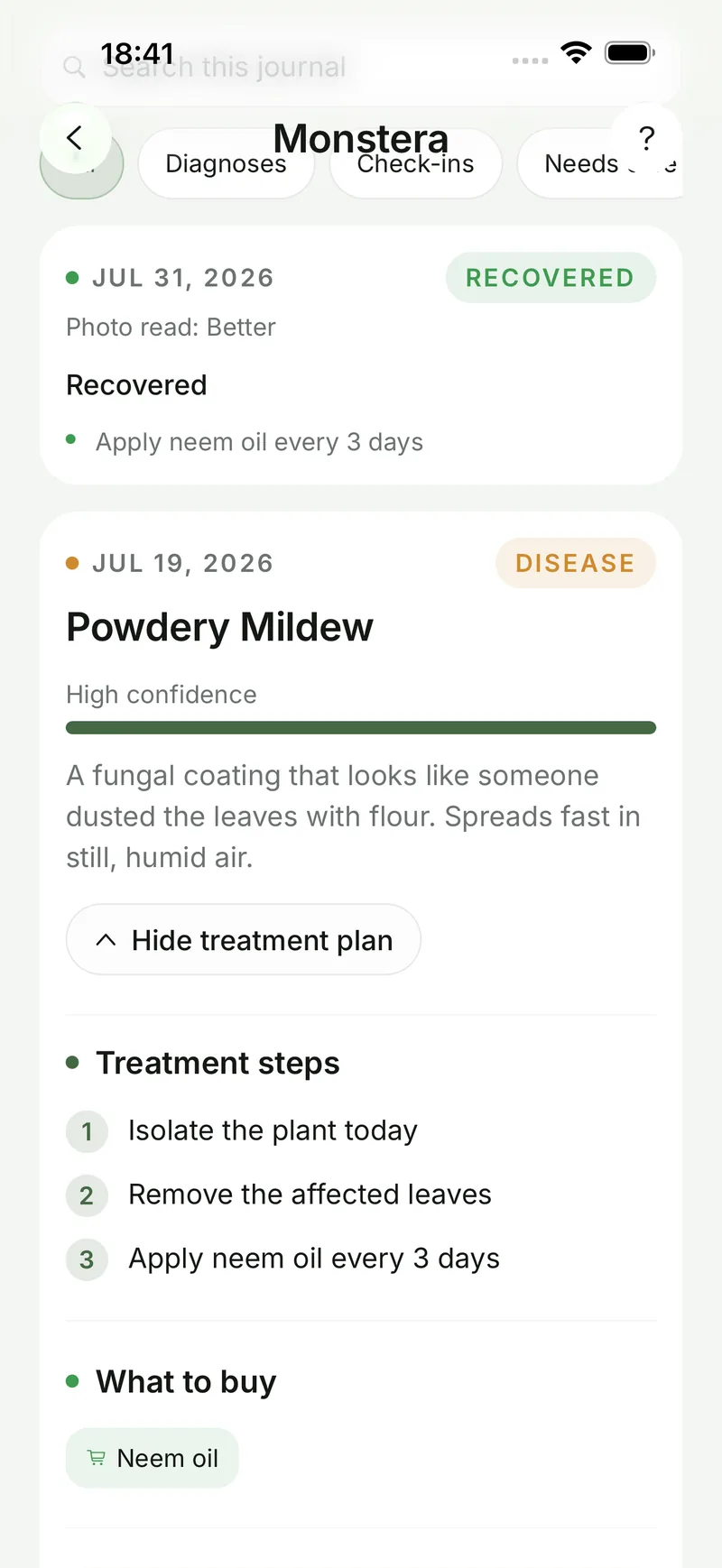
Each result shows confidence, urgency and whether the problem can spread, then lists what to do in order.

Bofern app screen: A treatment plan, step by step

A treatment plan, step by step

  • Clear steps in the order you should do them
  • What to buy, so you shop for the right product
  • What to avoid, so a well-meant fix does not make things worse
  • When to check back, so you know whether it is working

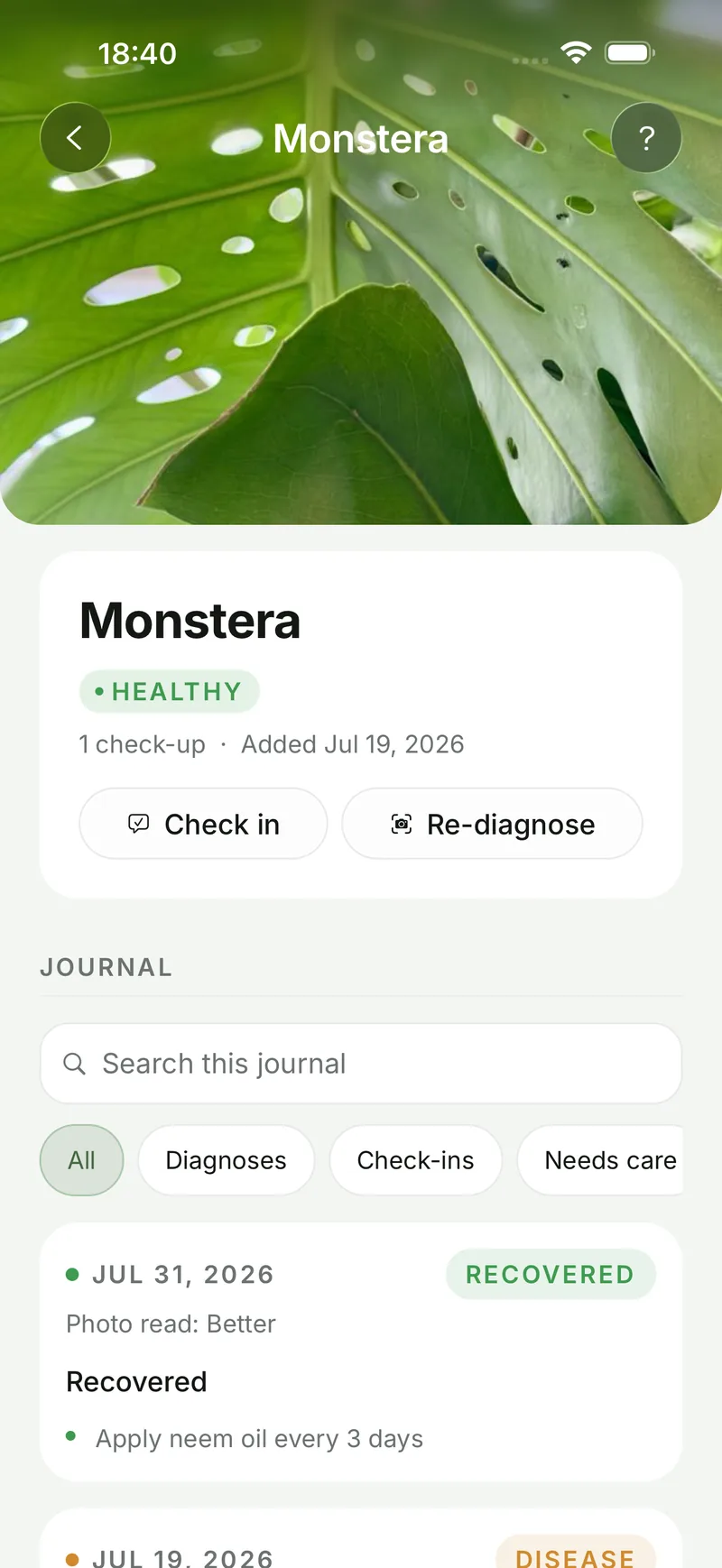
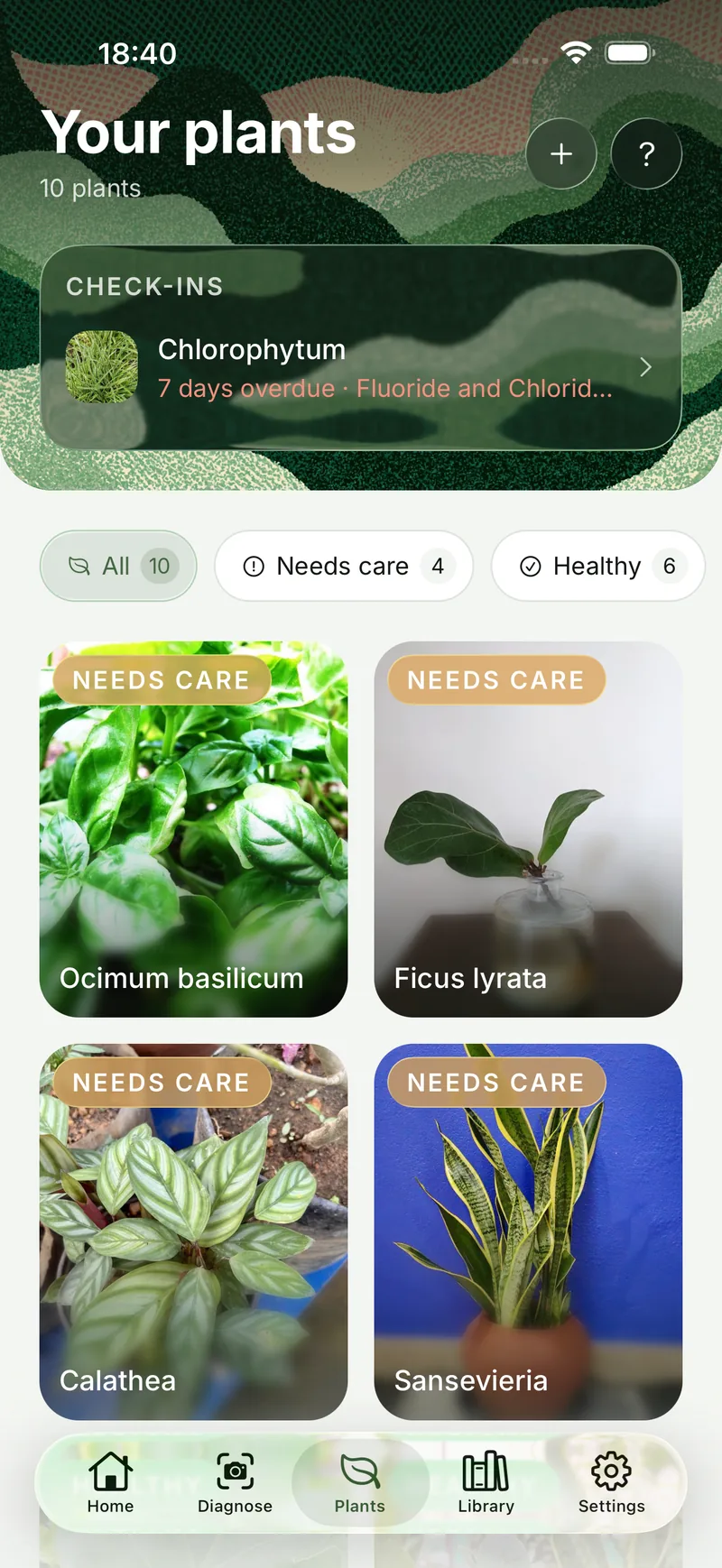
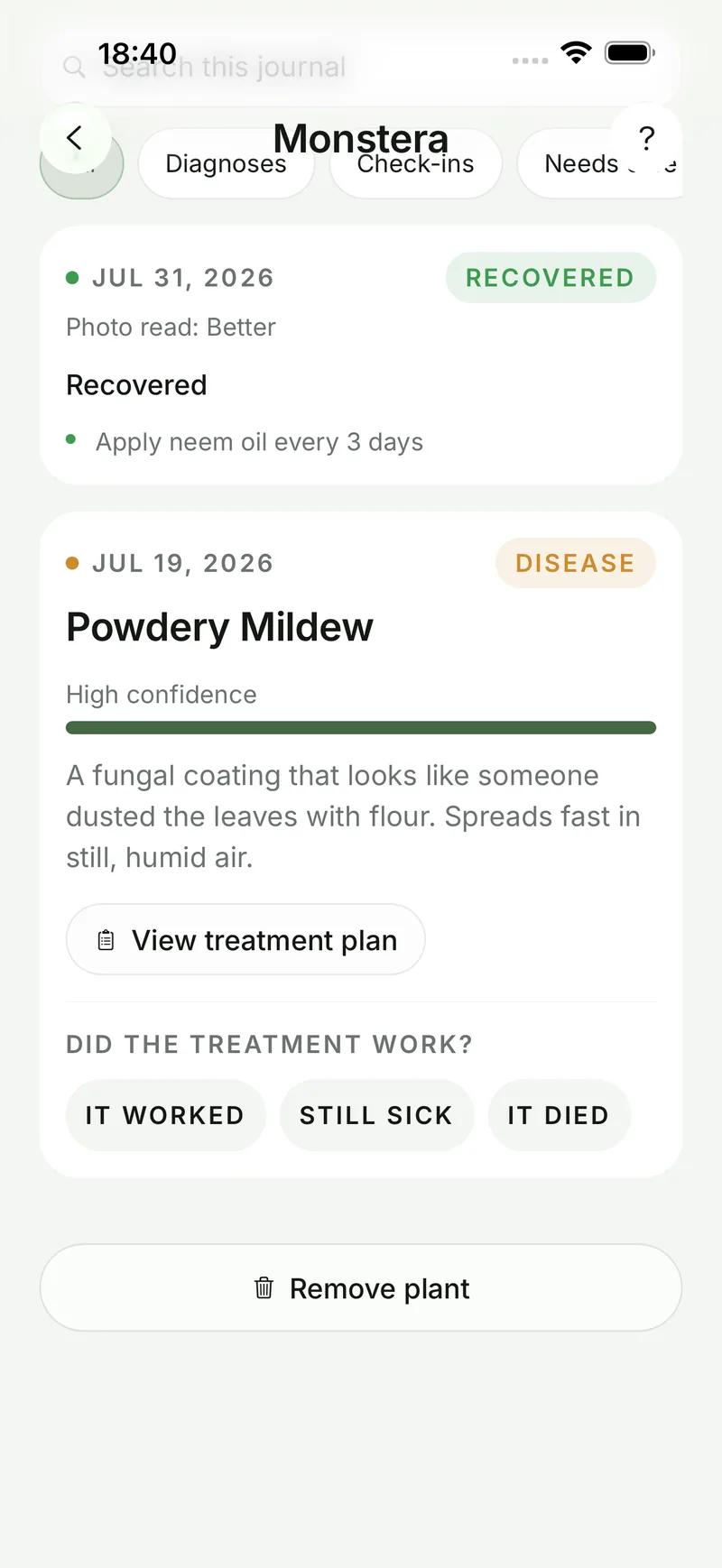
Save each plant with its photo and history, and log whether a treatment worked.

Bofern app screen: A plant journal that remembers

A plant journal that remembers

  • Every diagnosis saved to the right plant
  • Log outcomes: it worked, still sick, or it died
  • Healthy and needs-attention status at a glance
  • Follow-up check-ins with Bofern Pro

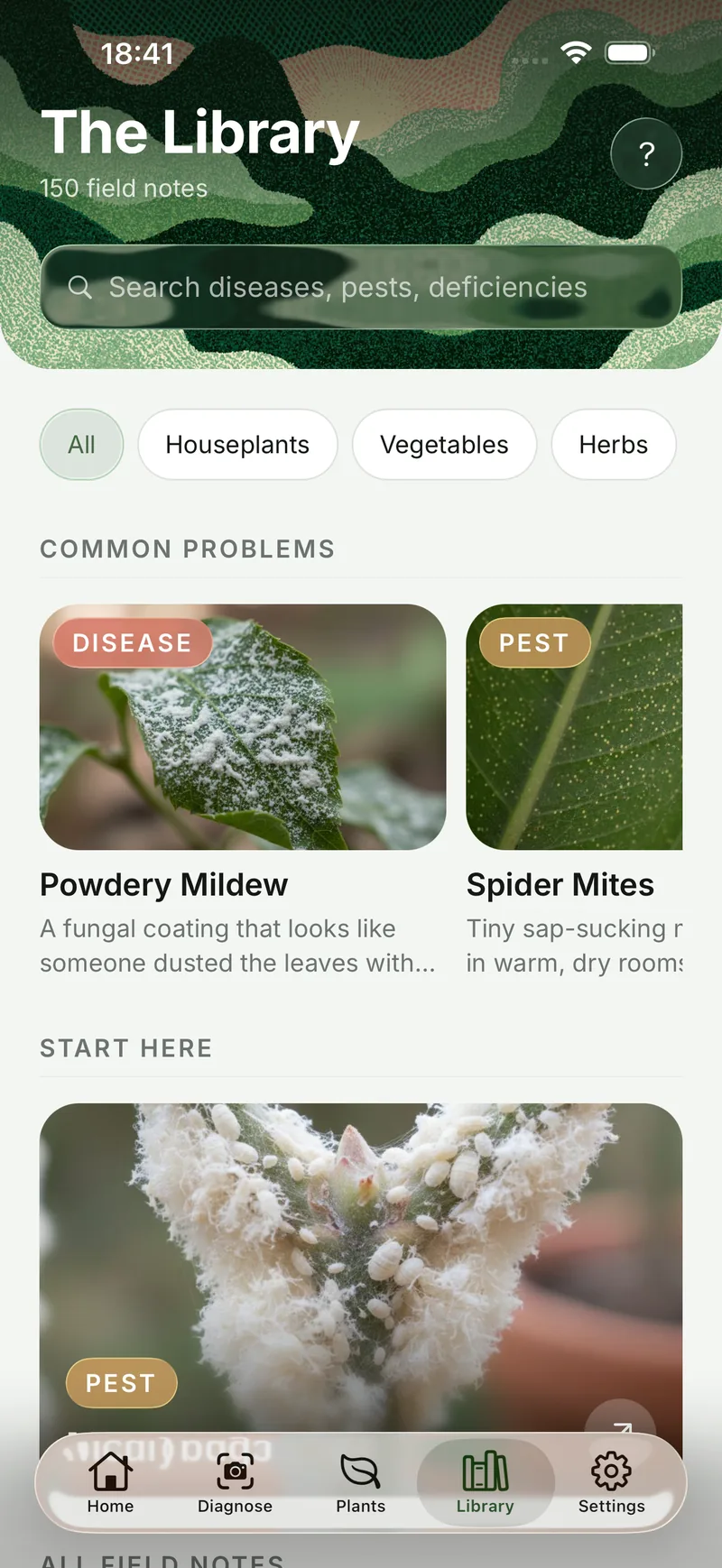
Browse 150 field notes on diseases, pests, deficiencies and environmental problems, or search for the one you suspect.

Bofern app screen: A plant disease library

A plant disease library

  • What to look for, likely causes and prevention for every entry
  • Browse by category or search by name
  • In 10 of the app's 16 languages, and in English in the others
  • Included for every signed-in account, with or without Pro

Quick plant health tips Small habits that prevent most of the problems people bring to a plant doctor.

Check the soil, not the calendar

Push a finger into the mix before you water. Most houseplants want the top inch or two to dry first; a fixed weekly schedule ignores season, light and pot size.

Always use a pot with drainage

Water that cannot escape sits around the roots and starves them of oxygen. If you love a decorative pot without holes, use it as a sleeve around a plastic nursery pot.

Empty the saucer

Tip out water that collects in the saucer or cachepot after watering. A plant standing in water is the classic setup for root rot.

Look at the roots when in doubt

Healthy roots are firm and pale. Brown, mushy roots that smell sour mean rot, and no amount of fertilizer will fix that until the roots are dealt with.

Made for sick plants

Most plant apps tell you the species. Bofern looks at the problem and tells you what to do about it.

Bofern app screen: Made for sick plants

Pricing Sign in with Apple or Google to start. Upgrade only if your plants need ongoing care.

Free

For a first look at a sick plant

  • 3 free diagnoses, ever
  • Plant journal and treatment log
  • The full plant problem library
  • Sign in with Apple or Google
Download Bofern
Recommended

Pro

Monthly, quarterly or yearly

  • 30 diagnoses or check-ins a month
  • Photo check-ins to see if a treatment works
  • Same allowance on monthly, quarterly or yearly
  • Photos it can't read don't count
Get Pro in the app

US list prices for Bofern Pro are $9.99 per month, $24.99 per quarter and $89.99 per year. Prices in other countries are set locally, so see the in-app price for your country before you subscribe. Subscriptions renew automatically until cancelled in your Apple account settings.

Frequently asked questions

  • You take a photo or pick one from your library. Bofern compresses it on your device and sends it to an AI vision model, which returns the most likely disease, pest, nutrient deficiency or environmental problem, a confidence level, urgency, whether it can spread, and a step-by-step treatment plan.

  • A clear, close photo of the symptom gives the best result, and Bofern shows an honest high, medium or low confidence level so you know how much weight to give it. AI can be wrong. For a valuable, rare, edible or medicinal plant, confirm with a local extension service or a qualified professional before you treat.

  • The most common cause is watering, especially soil that stays wet so the roots cannot breathe. Low light, nutrient shortages, pests and natural aging of old lower leaves are the other usual suspects. Where the yellowing starts, old leaves or new growth, is the best first clue.

  • A dusty white coating that wipes off and comes back is usually powdery mildew, a fungal disease. White cottony clumps in leaf joints are more likely mealybugs, and a chalky film after watering can be mineral residue. Bofern can tell you which one it most likely is from a photo.

  • Many fungal and bacterial diseases and almost all pests can spread, while watering, light and nutrient problems cannot. Every Bofern result includes a contagious or not contagious chip, and if it can spread, the first step is to move the plant away from its neighbors.

  • Yes. Bofern requires Sign in with Apple or Google before you can diagnose a plant. There is no email and password login. Your verified account keeps your journal private and syncs it across your devices.

  • You get 3 free diagnoses in total, not per month. They are tied to your Apple or Google sign-in, so deleting and recreating your account doesn't reset them. The plant journal and the full plant problem library stay available with or without Pro.

  • Bofern Pro gives you 30 diagnoses or check-ins a month, in any mix. Check-ins are Pro only. Monthly, quarterly and yearly plans all get the same 30 a month.

  • In the US, Bofern Pro is $9.99 per month, $24.99 per quarter or $89.99 per year. Prices in other countries are set locally and shown in the app before you buy.

  • Photos are compressed on your device before they are sent. A diagnosis photo goes to an AI provider to produce the result, and the app asks your permission before the first one. Stored photos sit in a private bucket reachable only through short-lived links, and deleting your account deletes them.

  • No. Bofern has no advertising, no tracking and no third-party analytics.

  • Yes. Bofern recognizes common plant pests including spider mites, mealybugs, scale, thrips, aphids and fungus gnats. A close, sharp photo of the insects or the damage, including the underside of a leaf, gives the clearest read.

  • Yes. Bofern diagnoses problems on houseplants, garden ornamentals, vegetables and fruit, such as blight on tomatoes or black spot on roses. For food crops, always check that any product you use is labeled for that crop and follow the label.

  • Get close so the symptom fills the frame, use daylight or bright indoor light, and hold still so the photo is sharp. Include the underside of the leaf if you suspect pests. One clear close-up beats a wide shot of the whole plant.

  • Bofern runs on iPhone and iPad and is available in 16 languages: English, German, Spanish, French, Italian, Portuguese (Brazil), Japanese, Korean, Simplified Chinese, Turkish, Dutch, Polish, Russian, Indonesian, Vietnamese and Thai. Diagnoses appear in the language you choose. The plant problem library is translated into the first ten of these; in Dutch, Polish, Russian, Indonesian, Vietnamese and Thai its entries appear in English.

Still have a question? Contact

The practical guide to plant health

Most plant problems leave signs you can read. This guide covers how experienced growers diagnose a struggling houseplant or garden plant: read the symptom, rule out the common causes in the right order, treat safely, and know when to start over. Use it with the step-by-step guides on our blog, or with a photo diagnosis in Bofern when you want a second opinion.

Start with what healthy looks like

You cannot spot a problem until you know your plant's normal. Healthy foliage has consistent color for the species, firm leaves that hold their shape, and new growth that looks at least as vigorous as the old. Variegated plants are supposed to have pale patches; a snake plant is supposed to be stiff and upright; succulents naturally shed a few of their lowest leaves as they grow.

Some change is simply aging. Most plants let their oldest, lowest leaves yellow and drop now and then, and that is not a disease. What matters is the pattern: one old leaf yellowing every few weeks is normal, while several leaves at once, yellowing on fresh growth, or spots that keep spreading deserve attention.

It helps to take a reference photo when a plant is thriving. When something changes, you have a baseline to compare against instead of relying on memory. A plant journal, whether a notebook or the journal in Bofern, makes it much easier to see whether a problem is getting better, getting worse, or holding steady.

Read the symptom: where, what pattern, how fast

Before you reach for any product, answer three questions.

Where is it? Problems on old, lower leaves often point to mobile nutrients such as nitrogen or magnesium, to watering, or to normal aging. Problems on new growth point to immobile nutrients such as iron, to root damage, or to pests that feed on tender tips. Problems on the side facing a window often mean light or heat damage.

What pattern? Uniform yellowing across a leaf reads differently from yellow between green veins (interveinal chlorosis), and both read differently from distinct spots. Spots with rings, spots with yellow halos, crispy edges, and soft, dark, water-soaked patches each narrow the list of suspects.

How fast? Sudden collapse over a few days suggests root rot, a cold shock, or a severe pest problem. Slow fading over weeks usually points to light, nutrition or chronic watering habits.

Then ask what changed recently. A new spot by the window, a repot into a bigger container, a heater switching on for winter, a new plant arriving from the shop, a different fertilizer or a holiday that stretched the time between waterings: most plant problems start within a few weeks of a change like this. Writing down the date you noticed the symptom and anything that changed around it narrows the list faster than any single test. Also check the whole plant, not just the leaf that caught your eye. Look at the stem base for softness, the soil surface for mold or insects, and the undersides of a few leaves for specks or webbing.

Our step-by-step guide to diagnosing a sick plant turns these questions into a checklist you can run in a few minutes.

Water and roots: the cause behind most houseplant problems

If you only check one thing, check the soil. Roots need oxygen as well as water, and soil that stays soggy pushes out the air. Roots suffocate, start to rot, and stop taking up water, which is why an overwatered plant can wilt as if it were dry. That paradox fools a lot of people into watering even more.

Signs of overwatering include yellowing lower leaves, soft or mushy stems, soil that never dries out, fungus gnats flying around the pot, and a sour smell. Underwatered plants have bone-dry soil that pulls away from the pot edge, crispy brown leaf edges, and leaves that perk up within hours of a good drink. Our guide to overwatering vs underwatering lays the two side by side.

When symptoms are confusing, slide the plant out of its pot. Healthy roots are firm and usually white or tan. Rotten roots are brown or black, slimy, and the outer layer slips off when you pinch it. If you find rot, act quickly: trim the damaged roots with clean tools and repot into fresh, well-draining mix. Our root rot rescue guide covers each step and when a cutting is a better bet than the parent plant.

Light, temperature and humidity

Light is a plant's food supply. Too little light shows up as slow, stretched growth with long gaps between leaves, small new leaves, fading variegation, and lower leaves dropping because the plant cannot support them. Too much direct sun shows up as bleached, tan or brown patches on the most exposed leaves, often appearing within days of moving a plant to a brighter spot.

Temperature shocks cause sudden trouble. Cold drafts from a door or a window in winter, or a plant left outside on a chilly night, can leave dark, water-soaked or blackened patches. Heat sources such as radiators and vents dry leaves out and invite spider mites.

Dry indoor air, especially when heating is running, is a common cause of brown, crispy leaf tips on tropical plants such as calatheas and some palms. Grouping plants, keeping them away from heat sources and watering consistently help more than occasional misting. If brown tips are your main complaint, our guide to brown tips on plant leaves separates humidity from fertilizer salts and watering swings.

Nutrient deficiencies: old leaves vs new leaves

Nutrient problems are less common in houseplants than watering problems, but they do happen, especially in plants that have lived in the same mix for years or in heavy feeders like tomatoes.

The location of the symptom is the key. Nitrogen, potassium and magnesium are mobile, so a plant short on them moves them out of old leaves to feed new ones. That is why nitrogen shortage shows up as general yellowing of older leaves, and magnesium shortage as yellowing between the veins of older leaves. Iron is not mobile, so iron deficiency shows up as yellow new leaves with green veins.

Before you add fertilizer, rule out the roots. Damaged or waterlogged roots cannot absorb nutrients even when the soil is full of them, and soil pH that is too high can lock up iron. Feeding a stressed plant with damaged roots can make things worse. Our nutrient deficiency guide shows the classic patterns for each nutrient and how to fix them without overdoing it.

Pests: find them before they find your other plants

Most houseplant pests are small, slow and easy to miss until there are a lot of them. Make a habit of flipping leaves and checking leaf joints whenever you water.

  • Spider mites leave fine pale speckling on leaves and, later, delicate webbing. They thrive in warm, dry rooms. See our spider mite guide.
  • Mealybugs look like small tufts of white cotton in leaf joints and along stems.
  • Scale looks like little brown bumps that do not wipe off easily.
  • Aphids cluster on soft new tips and flower buds.
  • Fungus gnats are tiny dark flies around the soil, a sign that the mix stays too wet. Our guide to getting rid of fungus gnats explains why drying the soil matters more than any spray.

Sticky leaves, or black sooty film on leaves and furniture, usually mean sap-feeding insects are producing honeydew somewhere above. The first response to almost any pest is the same: isolate the plant, physically remove what you can, and wash the foliage. Labeled products such as insecticidal soap or horticultural oil come next, always used exactly as the label says and usually repeated, because eggs survive the first round.

Fungal and bacterial disease: spots, mildew and rot

Plant diseases are caused mostly by fungi, fungus-like water molds, and bacteria. They thrive where leaves stay wet, air does not move, and plants are crowded or stressed.

Powdery mildew looks like a dusting of white powder on leaf surfaces. It is common on roses, squash, begonias and many other plants. Our guide to white powder on plant leaves covers what helps and which popular home remedies have weak evidence.

Leaf spots come in many forms. Fungal spots often have rings or dark borders; bacterial spots often look water-soaked, sit between the veins, and carry a yellow halo. Our guide to brown spots on plant leaves walks through the look-alikes, including non-infectious causes such as sunburn.

Rots affect roots, crowns and stems and are usually tied to too much water. They are often more urgent than leaf spots because the plant's plumbing is failing.

For most leaf diseases, the backbone of control is the same: remove infected leaves, water the soil rather than the foliage, improve airflow, and clean up fallen debris. Labeled fungicides are mainly protective. They help keep healthy leaves from getting infected but do not cure spots that are already there.

Treating safely: least-toxic first, labels always

The safest treatment is usually the simplest one that solves the problem. Work through options in this order:

  1. Fix the conditions. Correct watering, light, airflow and spacing. Many problems stop here.
  2. Remove the problem physically. Prune infected leaves, wipe or rinse off pests, discard badly infested growth.
  3. Use targeted, lower-risk products. Insecticidal soaps, horticultural oils, Bti for fungus gnat larvae, and labeled fungicides for specific diseases.
  4. Escalate only if needed, and only with products labeled for your plant, your pest or disease, and indoor or outdoor use as appropriate.

Read the whole label before you buy and again before you apply. The label is the legal set of directions: it tells you the rate, how often you can repeat, which plants may be sensitive, and for food crops how long to wait before harvest. Do not mix products together unless the label says you can, test sprays on a single leaf first, and avoid spraying in strong sun or heat. Be wary of viral home remedies with precise recipes; some do little, and some damage leaves.

Isolate, track, and know when to start over

When a problem might be contagious, move the plant away from its neighbors before you do anything else. Pests walk and blow between plants that touch, and many fungal spores travel on splashing water or on your hands and tools. Clean pruners between plants.

Then track the recovery. Note what you did and when, and take a photo from the same angle every week or so. Damaged leaves rarely turn green again, so judge progress by new growth and by whether the symptom is still spreading. Bofern's plant journal lets you save each diagnosis to a plant and log whether the treatment worked, still sick or not, which turns guesswork into a record.

Know when to stop. If the roots and stem base are mushy all the way through, if a pest keeps coming back after several thorough rounds, or if a disease has reached most of the plant, the kindest option may be to take a healthy cutting and discard the rest. Many popular houseplants, including pothos, monstera and snake plants, propagate easily from healthy sections.

How to photograph a sick plant for a diagnosis

A garden center, an extension office or an app can only judge what your photo shows.

  • Get close. Fill the frame with the affected leaf, stem or fruit. One sharp close-up beats a wide shot of the whole plant.
  • Use good light. Daylight from a window or bright indoor light shows true colors. Avoid flash glare and deep shadows.
  • Hold still. Tap to focus and let the camera settle so fine details such as specks, webbing or rings stay sharp.
  • Show the underside. Many pests and some diseases are visible only under the leaf.
  • Add context if needed. A second photo of the whole plant, the soil surface or the roots can explain what a single leaf cannot.

In Bofern, you can take the photo in the app or choose one from your library. If the image is too blurry or dark to read, the app tells you instead of guessing, and the confidence level on each result shows how much room for doubt the photo left. For a valuable, rare or edible plant, treat any AI result as a starting point and confirm with a qualified professional.

Plant problem guides

Symptom-first guides that help you work out what is wrong and what to do next.

Start with one photo

Bofern tells you the most likely problem, how sure it is and what to do next.

Download on the App Store